
Learning From Life, Serving Life
Where nature becomes mentor — and students become custodians. Learning from 3.8 billion years of biological wisdom, students develop regenerative thinking: design that serves life, not just human convenience.
→ Explore The Biomimicry Hive
Nature has been solving engineering problems for 3.8 billion years. But the Biomimicry Hive is not just about extracting nature's solutions. It is about developing a relationship with nature — learning to see all living beings as teachers, as relatives, as fellow participants in the web of life.
Traditional education treats nature as resource — something to use, to extract from, to control.
The Biomimicry Hive teaches a different orientation: nature as mentor. Not something to learn about, but something to learn from. Not something to take from, but something to receive from — with gratitude, with reciprocity, with care.
This shift begins with humility. Evolution has solved most problems we're trying to solve. Our task is not to conquer nature but to learn from it — and in learning, to serve it.
In the first plane, Montessori children develop Care of Plants and Animals — sensitivity to living beings. In the Biomimicry Hive, this sensitivity becomes scientific discipline and ethical foundation.
Students don't just study organisms. They develop relationship with them. The gecko whose feet they study is not just a mechanism to reverse-engineer. It is a being with 200 million years of evolutionary wisdom. It has something to teach. The proper response is not just curiosity but respect.
Every investigation in the Hive begins with awareness: this organism is alive. It has its own purposes. We are guests in its world, students of its wisdom.
Montessori taught that every organism has a cosmic task — a contribution to the whole. The earthworm aerates soil. The bee pollinates flowers. Nothing exists for itself alone.
In the Biomimicry Hive, students ask: What is my cosmic task? What is humanity's cosmic task?
They develop custodian consciousness — the understanding that humans are not owners of the Earth but caretakers. Our innovations must serve the whole web of life, not just human convenience.
Nature produces no waste — everything cycles. The Biomimicry Hive teaches students to think in cycles, not lines. Not "take-make-dispose" but "take-make-return."
Students become regenerative engineers — designers who don't just minimise harm but actively contribute to ecological health.
The question is never just "Is this sustainable?" but "Does this regenerate? Does this give back more than it takes?"
This is conscience at ecological scale: awareness that every design choice affects living systems, and commitment to choices that serve life.

Gecko Adhesion: Students study gecko feet — but also ask: What is our obligation to geckos? How do we ensure our biomimicry benefits, not harms, their species?
Termite Ventilation: Students design passive cooling — but also study how termites cooperate, how colonies function as superorganisms. What can we learn about community?
Seed Dispersal: Students apply principles of passive flight — but also participate in the Seed Bank, preserving genetic diversity. Taking and giving back.
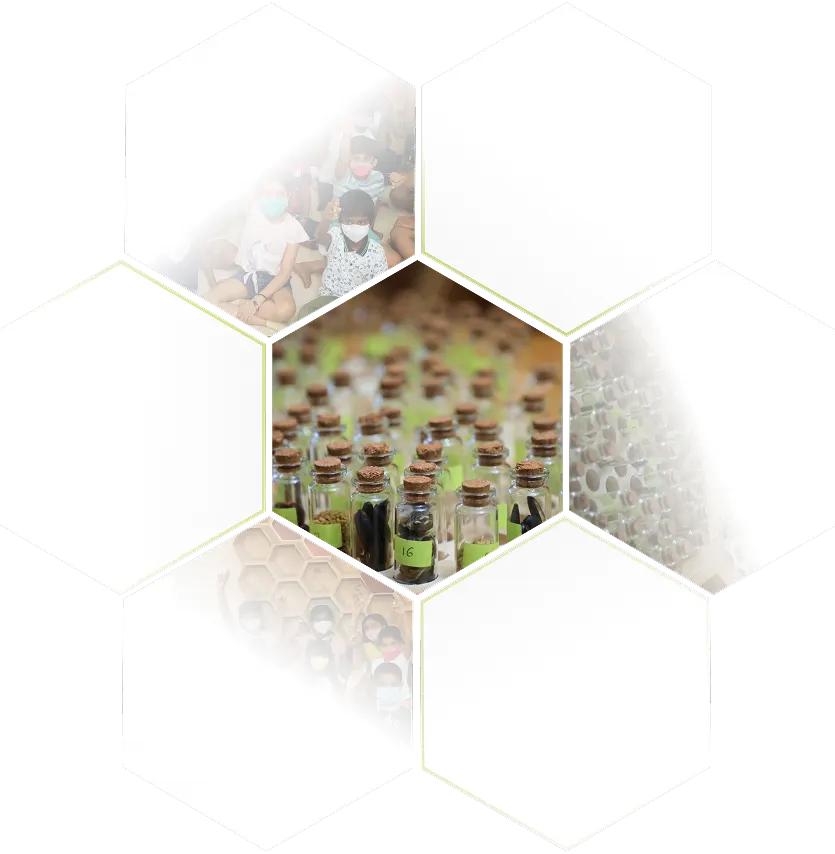
The Seed Bank: A long-term project of preservation and reciprocity. Students don't just learn from seeds; they serve them, ensuring their continuation.
Students who work in the Biomimicry Hive develop not just technical capability but a regenerative orientation to life. They carry this into all their work: the Innovation Lab, the Drone Lab, the Space Lab.
The question they bring everywhere: Does this serve life? Does this honour the Earth? Does this regenerate rather than extract?
This is Cosmic Education become conscience — understanding become care, knowledge become responsibility, learning become love.
Seats are filled on a first-come basis.
Book Admission Workshop